March 9, 2009

Trokosi: Ritual servitude

Juliana Dogbadzi, a former Trokosi slave and recipent of the 1999 Reebok Human Rights Award

Ritual servitude is a practice in Ghana, Togo, and Benin where traditional religious shrines take human beings, usually young virgin girls in payment for services, or in religious atonement for alleged misdeeds of a family member. Tro means deity and kosi means slave or wife so Trokosi translates as slave or wife of the deity.


These shrine slaves serve the priests, elders and owners of a traditional religious shrine without remuneration and without their consent, although the consent of the family or clan may be involved. Those who practice ritual servitude usually feel that the girl is serving the god or gods of the shrine and is married to the gods of the shrine.


These girls are sexually abused, serve at hard labor without compensation, suffer harsh punishment, and are denied education and human affection. If a girl runs away or dies, she must be replaced by another girl from the family. Some girls in ritual servitude are the third or fourth girl in their family suffering for the same crime, sometimes for something as trite as the loss of trivial property. It is still practiced in the Volta region in Ghana, in spite of being outlawed in 1998, and despite carrying a minimum three year prison sentence for conviction. Among the Ewes who practice the ritual in Ghana, the practice is also called trokosi or fiashidi. In Togo and Benin it is called voodoosi or vudusi.


The most disturbing detail is that although the Trokosi system, alongside all traditional and cultural practices that violate the constitution of Ghana was banned in 1998 the practice is still very much alive. In some cases the practice has moved ‘underground’. Some members of the communities involved do not see Trokosi as a Human Rights violation but as a traditional and reliable way of dispensing and maintaining social justice. The researchers estimated the number of victims to be roundabout 1400. To date no one has been arrested or persecuted in spite of the law banning the practice. Tro means deity and kosi means slave or wife so Trokosi translates as slave or wife of the deity.


Beer drinkers sentenced to caning

A Sharia High Court in Malaysia has sentenced a man and a woman to caning for drinking beer. Mohamad Nasir Mohamad, a 38-year-old father of four, and 22-year-old waitress Noorazah Baharuddin (in picture), were each discovered last year consuming beer in Pahang bars. 's Sharia High Court fined Mohamad and Baharuddin each $1,400 and ordered that they be publicly whipped for their crimes.

Offenders are whipped with a long strip of rattan that cuts into the skin and leaves permanent scars to remind them of their punishment. According to the New Straits Times, the cane will be 1.22m long and 1.25cm thick. Mohamad and Baharuddin will be allowed to face their punishment wearing clothing.

(
PHOTO: NEW STRAITS TIMES PRESS)


Public Caning in Aceh and Sharia Tourism


An Acehnese woman kneels to be caned by Sharia law authorities Jan.12, 2007 in Banda Aceh, Indonesia.


Tourism authorities in Indonesia's Aceh province hope that this practice of Sharia or Islamic law will attract visitors. "We invite international tourists to visit Aceh to observe how an Islamic community lives and how the Islamic code of Sharia is applied," said Cipta Hunai, an Aceh tourism official, in an interview with Adnkronos International (AKI).

He said that Sharia law in Aceh was a tourist attraction because it allowed foreigners to see a reality, that perhaps, they did not already know. "Here the tourists can visit many mosques and see how a community lives under laws based on the Koran," he said. "


Muslim-devout Aceh is the only province in Indonesia allowed to apply Sharia law. However observers say that the application of Sharia in the province has harmed the rights of the poor and women.The Indonesian government agreed to allow Shariah law in Aceh four years ago as part of negotiations to end the 29-year war between separatist rebels and the military.

Canning is carried out in Aceh for crimes including the sale or consumption of alcohol, gambling or meeting a person of the opposite sex, that is not your husband, wife or family member, in a private place.


For Kurdish Girls, a Painful Ancient Ritual


The Widespread Practice of Female Circumcision in Iraq's North Highlights The Plight of Women in a Region Often Seen as More Socially Progressive. Launch Photo Gallery

Sheelan Anwar Omer, a shy 7-year-old Kurdish girl, bounded into her neighbor's house with an ear-to-ear smile, looking for the party her mother had promised.

There was no celebration. Instead, a local woman quickly locked a rusty red door behind Sheelan, who looked bewildered when her mother ordered the girl to remove her underpants. Sheelan began to whimper, then tremble, while the women pushed apart her legs and a midwife raised a stainless-steel razor blade in the air. "I do this in the name of Allah!" she intoned.

As the midwife sliced off part of Sheelan's genitals, the girl let out a high-pitched wail heard throughout the neighborhood. As she carried the sobbing child back home, Sheelan's mother smiled with pride.

Read more at: washingtonpost.com

March 8, 2009

Breast Ironing: A grim secret of Africa's women

"My mother took a pestle, she warmed it well in the fire and then she used it to pound my breasts while I was lying down. She took the back of a coconut, warmed it in the fire and used it to iron the breasts.I was crying and trembling to escape but there was no way."- Geraldin Sirri, a young student in Cameroon.

What is Breast ironing?
Breast ironing is a form of mutilation practiced in parts of Cameroon. A pubescent girl's breasts are flattened, usually by the girl's mother, in an attempt to make her less sexually attractive to men. This practice is believed to help prevent rape and early marriage. Grinding stones, pestles, belts, heated objects and breast bands are used to press or beat down the forming breasts. (Video)

Most tools are warmed before pounding the girls' chests

Is this really what women have to do to protect themselves from sexual assault? Some parents are just doing to so their daughters do not have consensual sex.

"Breast ironing is not a new thing. I am happy I protected my daughter. I could not stand the thought of boys spoiling her with sex before she completed school", one woman explained."Unfortunately, television is encouraging all sorts of sexual immorality in our children."

Prevalence

Breast ironing appears to be most widely-practiced in Cameroon. It's more common in the Christian and animist south of the country than the Muslim north, where only 10 per cent of women are affected.

*It also occurs in Guinea-Bissau, West and Central Africa, including Chad, Togo, Benin, Guinea-Conakry.

*Some 24 per cent of girls in Cameroon, about one girl in four, undergo breast ironing.

*Breast ironing occurs extensively in the 10 provinces throughout Cameroon.

*A sample survey published in January 2006 of 5000 girls and women aged between 10 and 82 in Cameroon, estimates that 4 million women had suffered the process.

*Today, 3.8 million teenagers are threatened with the practice.

*Up to 53 per cent of women and girls interviewed in the coastal Littoral province in the southeast, where the country's main port, Douala, is situated, admit to having had their breasts 'ironed'.

*More than half (58 per cent) of cases breast ironing were undertaken by mothers. Other relatives also participate.

Health and Socio-Economic Implications

*Breast ironing is terribly painful and violates a young girl’s physical integrity.

*Breast ironing exposes girls to numerous health problems such as abscesses, itching, discharge of milk, infection, dissymmetry of the breasts, cysts, breast infections, severe fever, tissue damage and even the complete disappearance of one or both breasts.

*This painful form of mutilation could not only have negative health consequences for the girls, but often proves futile when it comes to deterring teenage sexual activity.

Female Suicide Bombers

What motivates a woman to carry out a deadly strike?
Many of the women are determined to avenge the deaths of loved ones. Islam Online featured an interview with Um Mustafa, a woman who was training to become a suicide bomber. After her husband and two children were killed in the U.S. offensive in Fallujah in 2004, Mustafa approached members of al-Qaida in Iraq and stated, "I will give my life to God wherever my leader tells me to do so."

However women may also turn to violence as a result of feeling depressed, or lacking a sense of purpose after the loss or detention of a family member. And terror experts also point out that as al-Qaida's network weakens in Iraq, it has turned to recruiting more women to keep its cause alive.


Slaughtered Apes

Officials of Virunga National Park in the Democratic Republic of Congo with the bodies of four mountain gorillas illegally slaughtered during the week of July 26 in this file handout photo released by International Gorilla Conservation Programme on August 10, 2007. Almost half the world's monkeys and apes are facing a worsening threat of extinction because of deforestation and hunting for meat, an international report showed on August 5, 2008. Photo: Reuters

March 6, 2009

Iranian Jews


Although Iran and Israel are bitter enemies, few know that Iran is home to the largest number of Jews anywhere in the Middle East outside Israel.While Jewish communities in Syria, Iraq, Yemen, Egypt, Morocco and Algeria have all but vanished, Iran is home to 25,000 Jews and most are determined to remain no matter what the pressures - as proud of their Iranian culture as of their Jewish roots. Jews have lived in Persia for nearly 3,000 years - the descendants of slaves from Babylon saved by Cyrus the Great.

"Khomeini, recognised Jews as a religious minority that should be protected. As a result Jews have one representative in the Iranian parliament. Imam Khomeini made a distinction between Jews and Zionists and he supported us," says Jewish community leader Unees Hammami. Just as it radically transformed Muslim society, the Iranian revolution calso changed the Jews. Families that had been secular before, started keeping kosher and strictly observing rules against driving on Shabbat. They stopped going to restaurants, cafes and cinemas - many such establishments were closed down - and the synagogue perforce became the focal point of their social lives.

Jewish women, like Muslim women, are required by law to keep their heads covered, although most eschew the chador for a simple scarf. But Jews, unlike Muslims, can keep small flasks of home-brewed wine or arrack to drink within the privacy of their homes - in theory, for religious purposes. Some Hebrew schools are co-ed, and men and women dance with each other at weddings.
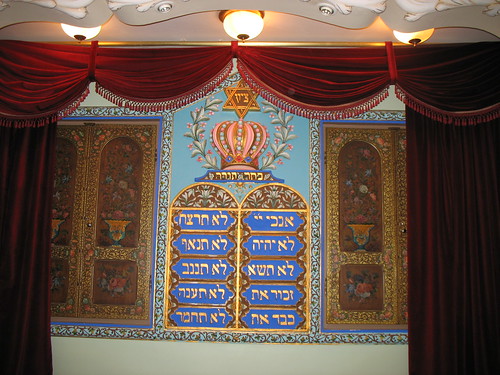
Synagogue in Esfahan (photo by G. Ross)


Mauritania: Fat women are beautiful, Thin women are disgusting !!!


Obesity is so revered among Mauritania's white Moor Arab population that the young girls are sometimes force-fed to obtain a weight the government has described as "life-threatening".Now only around one in 10 girls are treated this way. The treatment has its roots in fat being seen as a sign of wealth - if a girl was thin she was considered poor, and would not be respected.

Mint was 4 when her family began to force her to drink 14 gallons of camel’s milk a day. When she vomited, she was beaten. If she refused to drink, her fingers were bent back until they touched her hand. Her stomach hurt so much she prayed all the animals in the world would die so that there would be no more milk.By the time Mint was 10, she could no longer run. Unconcerned, her proud mother delighted in measuring the loops of fat hanging under her daughter’s arms.“My mother thinks she made me beautiful. But she made me sick,” says Mint, who suffers from weight-related illnesses including diabetes and heart disease.

To end the brutal feeding practices, the government has launched a TV and radio campaign highlighting the health risks of obesity. Because most Mauritanian love songs describe the ideal woman as fat, the health ministry commissioned catchy odes to thin women.These efforts, combined with the rising popularity of foreign soap operas featuring model-thin women, has helped reduce the practice, especially among the country’s urban elite.

Although few women are force-fed today, many feel pressured to be bigger-than-average. Many have turned to a more scientific method of weight gain, using foreign-made appetite-inducing pills.